|
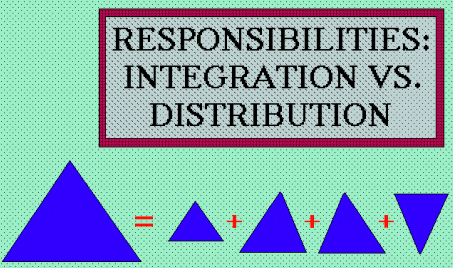
A professional Project Manager is able to take up responsibility for a project in its entirety, and still delegate part of those responsibilities - primarily the planning and control functions - to members of the Project Team.
In the non-project SME (like manufacturing or service enterprises) Project Managers are generally appointed "ad-hoc", for specific projects. Normally, managing a project is a part-time task for the Project Manager.
It is also possible that, besides managing one or more projects, the Project Manager is also an active member of the Project Team. Moreover, he has his normal work to take care of.
This demands a lot of flexibility: a part-time Project Manager in the SME needs to understand the several roles assigned to him/her and "swap hats" accordingly.

A Project Manager, to manage effectively a project, needs to have several distinct abilities. He should be:
- a good thinker
- a good planner
- a good organiser
- a good administrator
- a good co-ordinator of resources
- a good communicator
- a good decision-maker
- a good problem solver
- flexible, but determined
- target/result-driven
- extremely time/cost-conscious
- quality-driven
- a challenge lover
- capable of managing conflicts
Most important, a Project Manager must understand in full the project limits (the project main parameters: TIME-COST-QUALITY), and start-up the project only when the project's objectives and boundaries are clearly defined.
Technical knowledge of the object of the project is not strictly necessary. What is important is that one or more members of the Project Team have the technical knowledge required to "technically manage" the project.
Actually, it might be a mistake or a draw-back to appoint Project Manager of a project a technical expert in the project's field. Especially when the person does not have the other essential skills and abilities required to manage "the project" (and not only its technical aspects).
The above core principles of Project Management apply in full to new Products/Services Development projects.
As said before, traditional Project Management has recently developed into Lean Project Management - (more »).
|


